SUMMARY
Manufacturing AI can identify patterns in production data, but data alone cannot fully explain what is happening inside a process or product. This article explores how physics and domain knowledge help AI predict hidden process conditions, understand cause-and-effect relationships, and deliver more reliable real-time decision support for manufacturers.
INDUSTRY
Automotive, Aerospace and Defence, Electronics, Home Appliances, FMCG, Energy, Process Industries, Advanced Manufacturing
RESOURCES
Manufacturing AI is often discussed as if more data automatically means better decisions.
But on the production floor, the problem is rarely that simple.
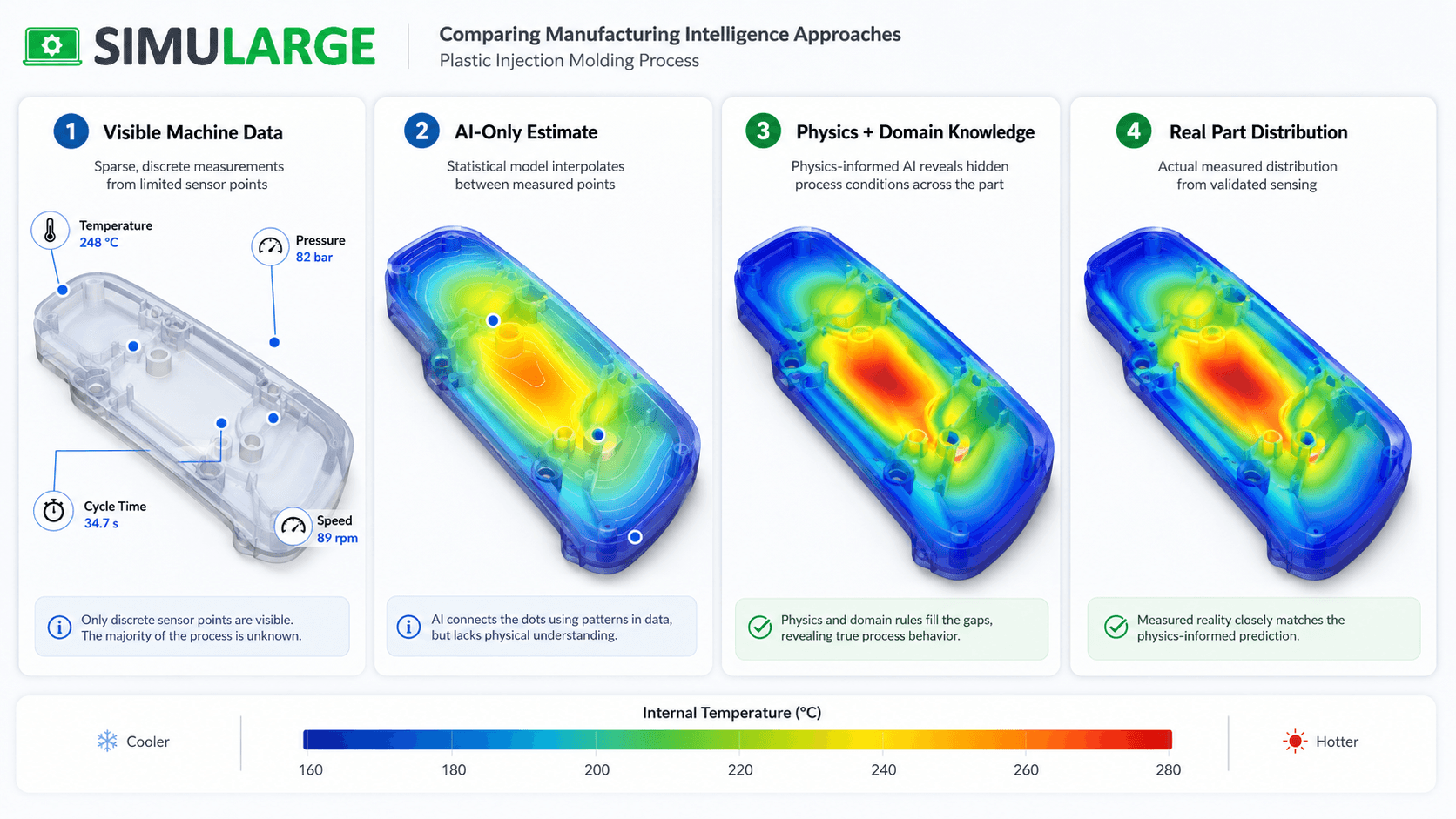
Machine data can show temperature, pressure, speed, current, vibration, cycle time, or flow rate. These signals are valuable. They help teams monitor equipment behaviour and detect visible changes in the process.
But they do not always explain what is happening inside the product or inside the process.
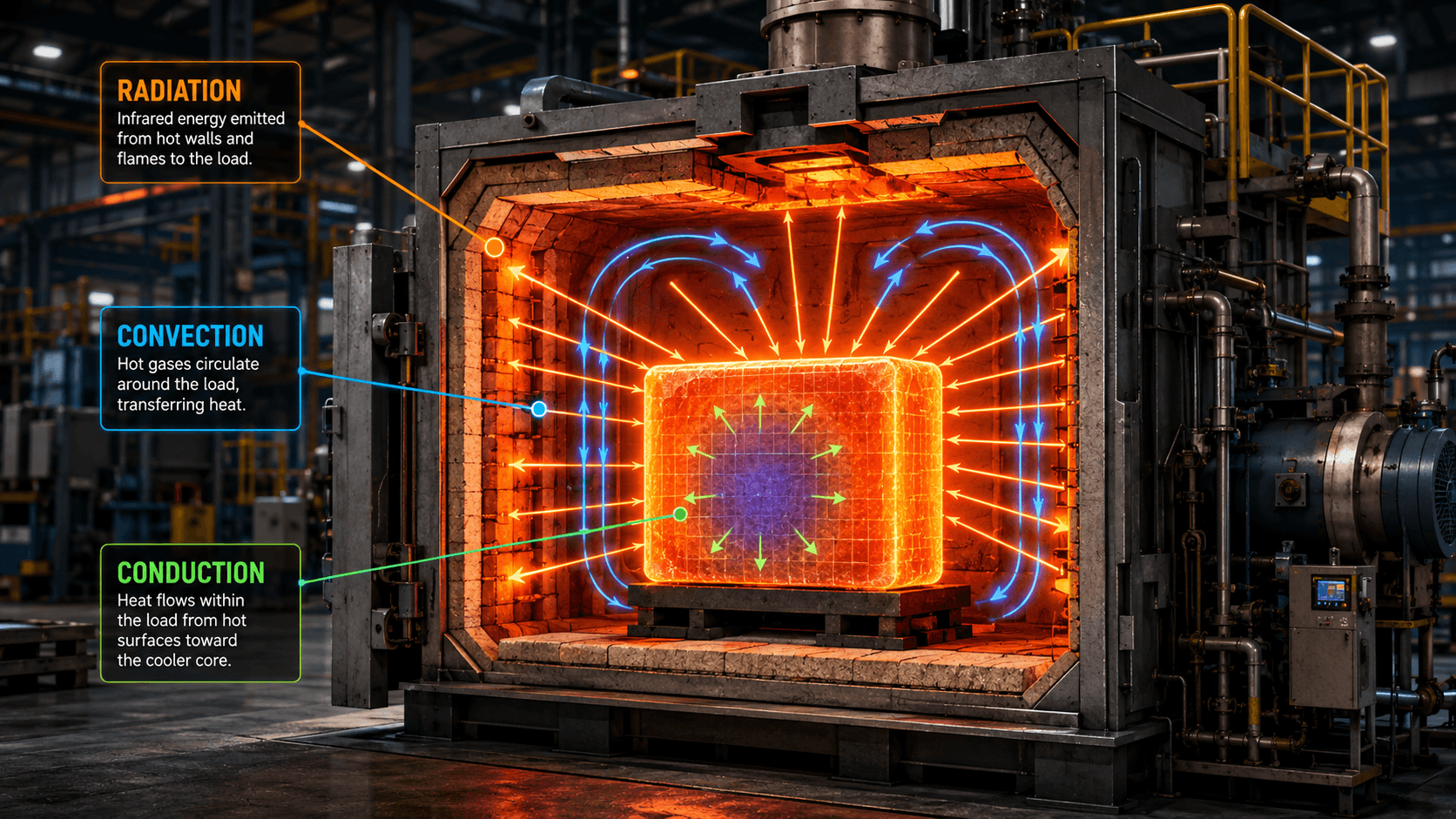
A sensor can measure the temperature of a tool, chamber, furnace, mould, or machine surface. It may not directly measure the internal temperature distribution of a part. A PLC can track pressure and cycle time. It may not reveal how material flow, cooling behaviour, residual stress, cure state, or deformation risk is developing.
This is the gap where manufacturing quality problems often begin.
Data Alone Shows Signals. Physics Explains Behaviour.
In many industrial processes, the same machine settings can still produce different outcomes.
Material batches change. Ambient conditions shift. Tools heat up or wear down. Geometry affects heat transfer, pressure distribution, cooling, stress formation, and material behaviour. Line speed changes how much time the product spends inside the ideal process window.
A data-only AI model may detect correlations in historical production data. It may learn that certain sensor patterns are often associated with scrap, rework, or quality deviation.
But correlation does not always explain cause.
For high-value, high-speed, or tightly controlled manufacturing processes, operators and engineers need more than a warning that something may go wrong. They need to understand what hidden process condition is changing, why it matters, and which parameter should be adjusted before the deviation becomes a defect.
That requires domain knowledge.
And in manufacturing, domain knowledge is physics.
Why Physics-Based AI Matters
A physics-based digital twin connects live production data with engineering models of the process and product.
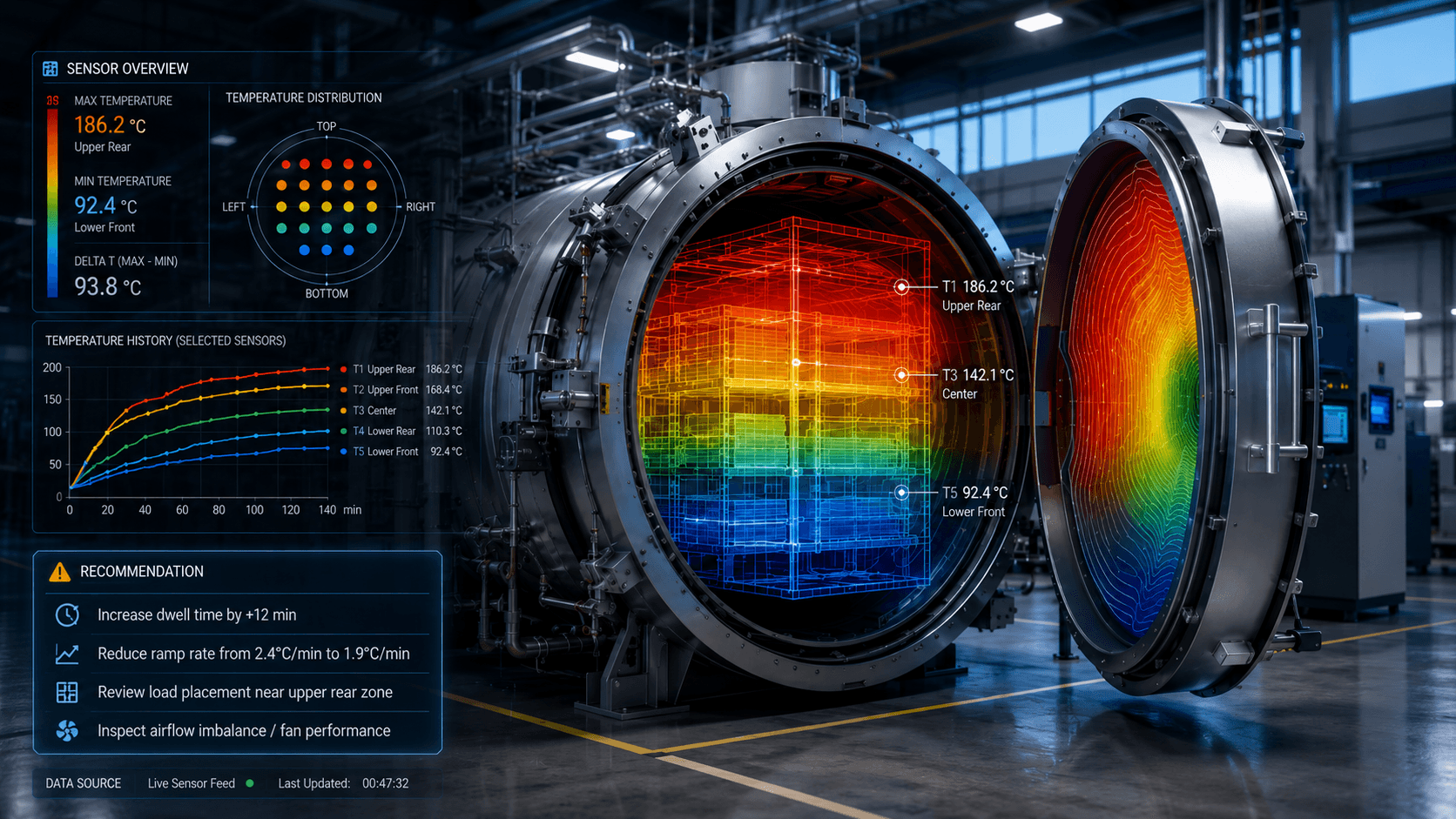
Instead of looking only at visible machine signals, it estimates internal and difficult-to-measure conditions such as temperature gradients, stress development, material flow behaviour, cure progression, seal formation, cooling performance, hardness evolution, or combustion stability.
This changes the role of AI in production.
AI is no longer only a pattern-recognition layer on top of machine data. It becomes part of a physics-based, real-time decision-support system that reflects how the process actually behaves.
For manufacturers, this distinction matters.
A model that only says “risk is increasing” may help teams react faster.
A system that says “this hidden process condition is moving outside the stable window, and this parameter should be adjusted now” can support prevention.
From Insight To Action
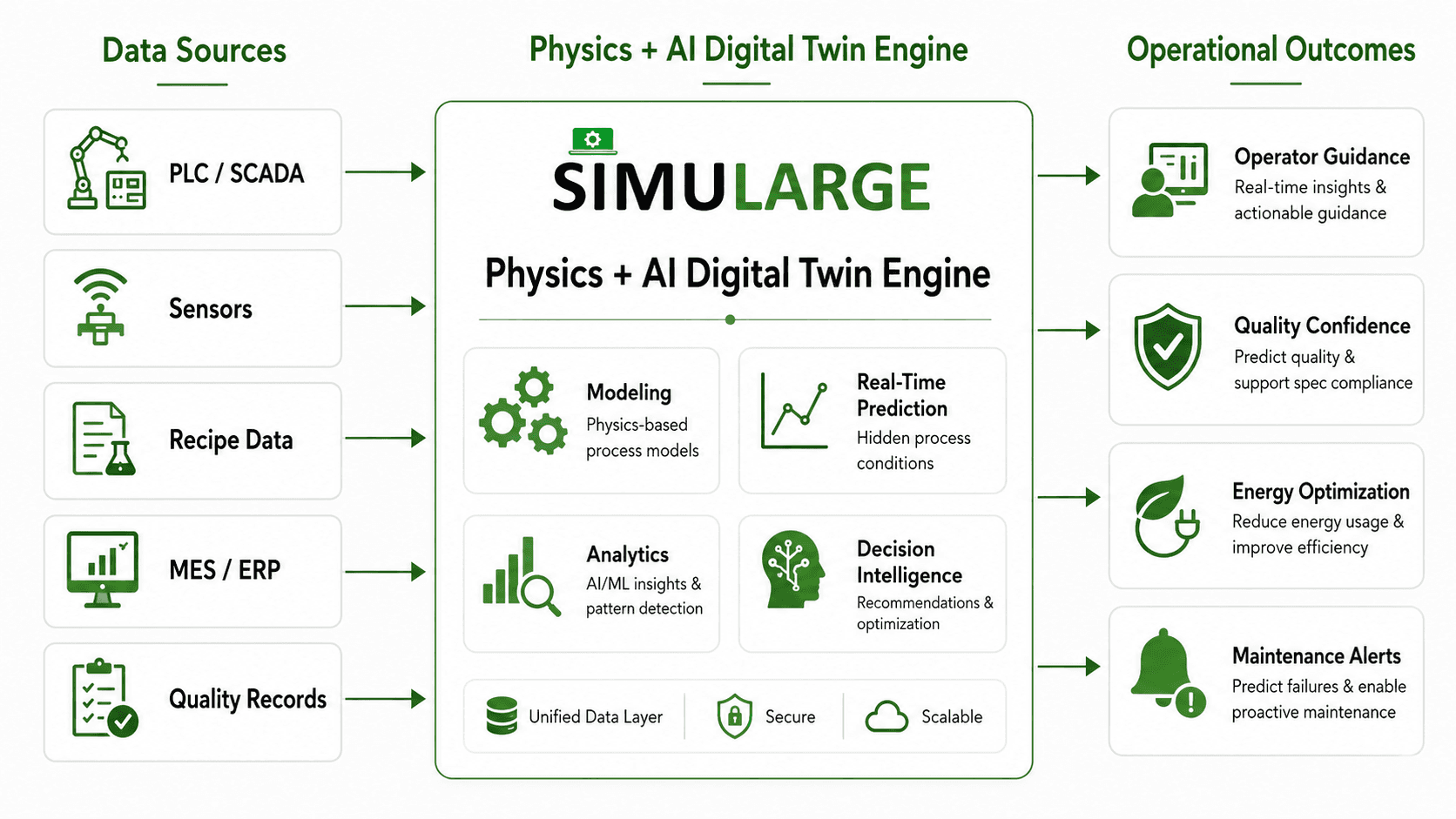
At Simularge, we position digital twins as in-production decision-support systems.
The operating logic is clear:
Connect to existing machine, PLC, and sensor infrastructure.
Use physics-based engineering models to estimate hidden process and product conditions.
Detect developing process deviations before they become confirmed defects.
Recommend corrective process adjustments.
Help operators and engineers stabilise production while the process is still running.
This is where physics-based, AI-enhanced process intelligence becomes commercially relevant.
It supports more consistent quality, reduced trial and error, faster root-cause identification, lower scrap and rework, better process reliability, and more stable production performance.
Manufacturing AI becomes more useful when it understands not only the data, but the process behind the data.
Because in real production, the most important variable is often the one no sensor can directly measure.
Have questions about how physics-based AI can support your production process? Contact us to discuss your use case.

Ready to get started ?
If this challenge sounds familiar, let’s discuss how Simularge’s physics-based digital twin technology can be applied to your production environment.