SUMMARY
Radiative heat transfer plays a key role in industrial furnace performance, affecting heat delivery, temperature uniformity, energy use, and process reliability. Its impact depends on furnace temperature, geometry, atmosphere, surface emissivity, product loading, and flow behavior. In high-temperature systems, radiation can become one of the dominant heat transfer mechanisms. Understanding furnace radiation helps connect thermal physics with practical decisions such as burner placement, product spacing, insulation strategy, operating conditions, simulation, and product quality control.
INDUSTRY
Heat Treatment, Steel Reheating, Aluminum Processing, Glass Melting, Ceramic Kilns, Industrial Ovens
RESOURCES
M. F. Modest, Radiative Heat Transfer, 3rd ed. Oxford, UK: Academic Press, 2013.
U.S. Department of Energy, Improving Process Heating System Performance: A Sourcebook for Industry, 3rd ed., DOE/GO-102012-3534, 2012.
L. Donato, C. Galletti, and A. Parente, “Self-updating digital twin of a hydrogen-powered furnace using data assimilation,” Applied Thermal Engineering, vol. 236, p. 121431, 2024, doi: 10.1016/j.applthermaleng.2023.121431.
Industrial furnaces are used to heat, cure, dry, melt, anneal, harden, or reheat materials under controlled thermal conditions. In these systems, heat transfer directly affects product quality, cycle time, energy consumption, and equipment lifetime.
A furnace does not heat the product through a single mechanism. Heat is transferred by conduction, convection, and radiation at the same time.
Conduction governs heat flow inside the product, fixtures, refractory walls, and insulation.
Convection transfers energy through hot gases, burner jets, recirculating flow, and buoyancy-driven motion.
Radiation transfers thermal energy in the form of electromagnetic waves, so it can carry energy across gases, vacuum regions, and open spaces inside the furnace.
In industrial furnaces, this exchange occurs between hot walls, flames, gases, heating elements, refractory surfaces, and product surfaces.
At elevated temperatures, radiation becomes especially important because it increases much faster with temperature than convection. This is why high-temperature furnaces cannot be evaluated only by gas temperature, burner capacity, or heater power. The way surfaces exchange radiation inside the enclosure can strongly influence how uniformly and effectively the product is heated.
The Physics Behind Furnace Radiation
The increasing importance of radiation at high temperature is described by the Stefan–Boltzmann relation. Under simplified assumptions, radiative heat transfer from one surface toward another can be written as:
q₁→₂ = ε₁ σ A₁ F₁₂ (T₁⁴ − T₂⁴)
Where ε₁ is the emissivity of the radiating surface, σ is the Stefan–Boltzmann constant, A₁ is the radiating surface area, F₁₂ is the view factor from surface 1 to surface 2, and T₁ and T₂ are absolute temperatures.
This relation gives two key messages for furnace applications:
First, radiation depends on the fourth power of absolute temperature, which means radiative heat transfer increases rapidly as furnace temperature rises.
Second, radiation is strongly affected by geometry through the view factor. Hot wall, flame region, or heating element will not transfer the same amount of radiation to every product surface. Product surface may heat more slowly when another part, fixture, baffle, or load blocks its line of sight to the main radiation source, reducing the view factor.
What Makes Furnace Radiation Complex?
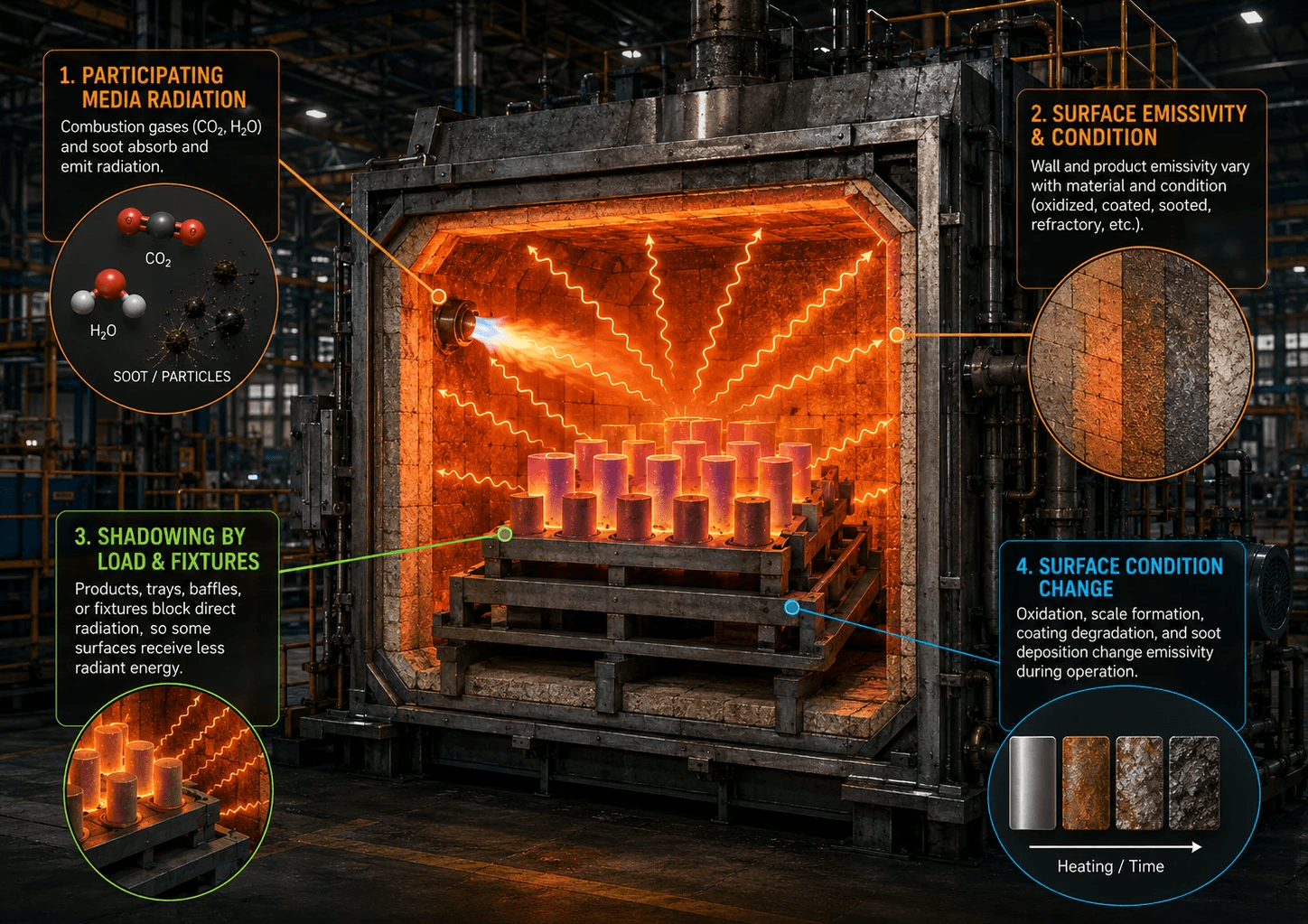
Industrial furnace radiation is rarely a simple exchange between two clean surfaces. The real behavior depends on furnace design, operating conditions, material condition, and the way the load is arranged. Key factors include:
• Surface emissivity: Polished metals, oxidized surfaces, ceramics, refractories, coatings, and soot-covered surfaces can radiate very differently.
• View factor and geometry: Radiation exchange depends on what each surface “sees” inside the furnace.
• Participating gases: In combustion furnaces, gases such as CO₂ and H₂O can absorb and emit thermal radiation.
• Soot and particles: Suspended particles can increase radiative exchange by absorbing and emitting thermal energy.
• Product loading: Dense loading can create radiation shadowing between parts, trays, fixtures, or baffles.
• Surface condition changes: Oxidation, scale formation, coating degradation, and soot deposition can change radiation behavior during operation.
For this reason, two furnaces operating at the same nominal temperature can show different heating behavior depending on geometry, atmosphere, loading pattern, and material condition.
The Operational Impact of Furnace Radiation
Radiative heat transfer affects how heat is delivered to different surfaces inside the furnace. A product surface that directly faces a hot wall, flame, or heating element may heat faster than a surface hidden behind another part, fixture, or baffle. This can create local temperature differences even when the measured gas temperature appears acceptable.
In combustion furnaces, CO₂, H₂O, flames, and soot can further influence radiation. In electric or vacuum furnaces, where gas participation is limited, surface-to-surface radiation can become the main radiative mechanism. Radiative effects influence:
• Temperature uniformity inside the load
• Heating and holding time
• Wall and product heat fluxes
• Thermal load on refractory surfaces
• Energy balance and heat losses
• Temperature gradients within the product
• Risk of overheating, underheating, distortion, or quality variation
This makes radiation analysis important not only for furnace design, but also for troubleshooting, energy efficiency, and continuous improvement.
How Radiation Is Represented in Engineering Models
Because furnace radiation depends on both surface exchange and gas participation, engineering models must be selected carefully. The right approach depends on furnace atmosphere, geometry, required accuracy, optical thickness, and computational cost.
Radiation model | Best suited for | Main limitation | Typical use |
|---|---|---|---|
Surface-to-Surface (S2S) | Opaque surfaces with transparent media | Does not model gas absorption or emission | Electric furnaces, vacuum furnaces, simplified enclosure radiation models |
Discrete Ordinates Method (DOM) | Participating media and combustion gases | Higher computational cost and possible ray effects | Detailed gas-fired furnace simulations with CO₂, H₂O, flame radiation, and spatial gas temperature variation |
P1 model | Optically thick participating media | Less accurate for directional radiation and localized flames | Preliminary or lower-cost furnace studies |
Rosseland model | Very optically thick media | Not suitable near boundaries or optically thin regions | Special cases where radiation can be approximated as diffusion |
Monte Carlo | High-fidelity radiation analysis | Very high computational cost | Research, benchmarking, and critical validation cases |
WSGG model | Non-gray gas radiation approximation | Depends on coefficient validity and gas composition | Gas radiation property modeling, often coupled with DOM or P1 |
In simple terms, S2S is useful when surface-to-surface radiation dominates and the gas can be treated as transparent. DOM is more suitable for gas-fired furnaces where participating media must be resolved. P1 and Rosseland are lower-cost approximations for optically thick media. Monte Carlo is usually reserved for high-fidelity studies. WSGG is commonly used with DOM or P1 to represent non-gray gas radiation from CO₂ and H₂O.
From Thermal Understanding to Smarter Furnace Decisions
When radiation is not represented correctly, the furnace may seem to operate within the expected temperature range while the product still receives uneven heat. This can create hidden operational losses such as longer heating or holding times, higher energy consumption, product quality variation, rework, scrap, trial-and-error tuning, refractory stress, and lower furnace throughput.
This is where thermal physics becomes a business decision. Better radiation understanding helps teams see whether a cycle is too conservative, whether product spacing should be changed, whether burner or heater placement creates local hot zones, or whether surface condition changes are affecting heat transfer.
In design studies, radiation analysis can guide decisions such as furnace geometry, burner or heater placement, product spacing, baffle layout, refractory selection, and insulation strategy. In operation, it helps answer practical questions:
• Why do some zones heat faster than others?
• Why does product quality change with loading pattern?
• Is the cycle longer or more conservative than necessary?
• Are surface condition changes affecting heat transfer?
• Can energy use be reduced without increasing quality risk?
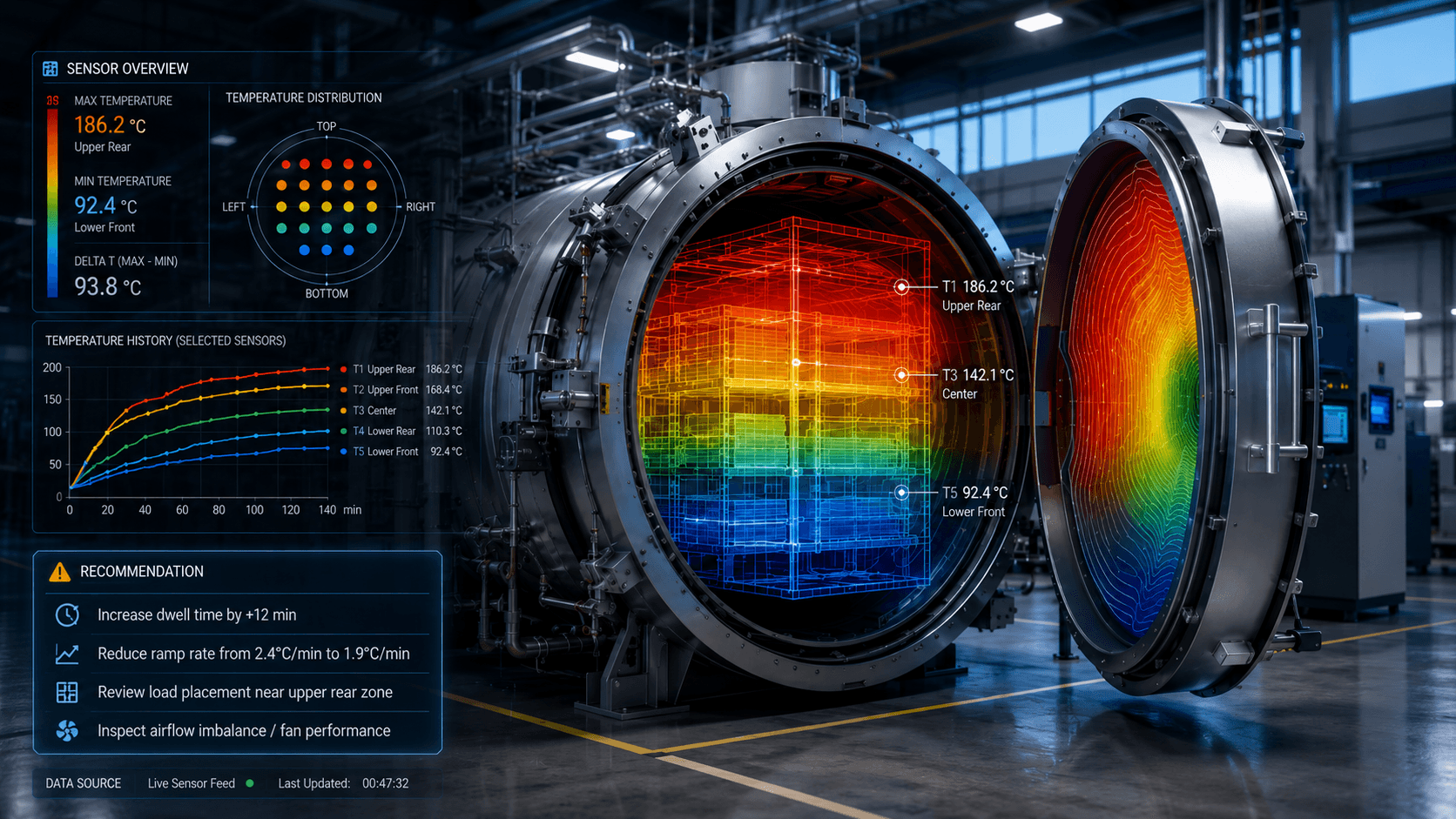
These questions are difficult to answer with isolated measurements alone. Thermocouples, pyrometers, heat flux sensors, flue gas data, and energy balance checks are all valuable, but each one shows only part of the furnace behavior. To understand the full thermal picture, these measurements should be connected with a physics-based furnace model.
This is where Simularge’s approach becomes valuable. By combining thermal simulation, radiation modeling, plant sensor data, and operational history, Simularge helps furnace teams:
• Compare expected and actual thermal behavior
• Test what-if scenarios before physical changes
• Investigate non-uniform heating
• Identify energy losses
• Understand the effect of geometry, loading pattern, and surface condition
A furnace digital twin built on realistic thermal physics can help teams move from isolated temperature readings to traceable process insight, more reliable scenario analysis, and smarter operating decisions.
Contact Simularge to explore how physics-based furnace simulation and digital twin workflows can help your team improve temperature uniformity, reduce energy waste, and make better process decisions in industrial furnace operations.
You might also like
these related posts


Ready to get started ?
If this challenge sounds familiar, let’s discuss how Simularge’s physics-based digital twin technology can be applied to your production environment.