SUMMARY
Autoclave digital twins connect machine data, load behavior, simulation, and AI to turn cycle data into actionable process intelligence. They help manufacturers improve visibility, troubleshoot faster, strengthen quality confidence, and identify opportunities in energy use, throughput, and maintenance.
INDUSTRY
Aerospace and Defense Composites, Automotive Lightweighting, Wind Energy, Marine Composites, Rubber Vulcanization, Glass Lamination
RESOURCES
NIST, “Digital Twins,” National Institute of Standards and Technology.
Why Chamber Data and Fixed Recipes Are Not Enough
Autoclave processes are usually based on validated or approved recipes. These recipes define the main cycle conditions, such as temperature ramp, dwell time, pressure, vacuum, cooling, and venting. This is necessary for process control and quality assurance, especially in regulated or high-value production.
However, a recipe mainly controls the chamber. It does not always show how the actual load behaves inside the autoclave.The same recipe can produce different results when the load changes.
In composite curing, part thickness, tooling mass, material behavior, vacuum quality, and airflow can affect how the part cures.
In sterilization, packaging type, load density, moisture, air removal, and item geometry can change how quickly the load reaches the required conditions.
In food retort processing, container size, fill level, product viscosity, and initial temperature can directly affect heat penetration.
This is the main operational gap: the chamber may follow the recipe correctly, but the load may not heat, cool, or respond uniformly. For manufacturers, the key question is not only “Did the cycle finish?” It is “Did the cycle produce the expected process conditions for this specific load?”
An autoclave digital twin helps answer this question by turning existing control and quality data into a process intelligence layer for better decision-making.
What Is an Autoclave Digital Twin?
NIST; describes digital twins as computer models of physical systems that support forecasting, monitoring, optimization, and decision support. An autoclave digital twin is a virtual representation of the autoclave system, the process cycle, and the load being processed. It is not just a 3D model, and it is not just a pressure or temperature model. It is a connected process model that can combine:
• PLC, SCADA, IoT, MES, ERP, and quality data
• Temperature, pressure, vacuum, flow, fan, valve, steam, or cooling signals
• Recipe parameters such as ramp rate, dwell time, cooling phase, exposure time, and venting strategy
• Product, material, tooling, tray, basket, container, or load layout information
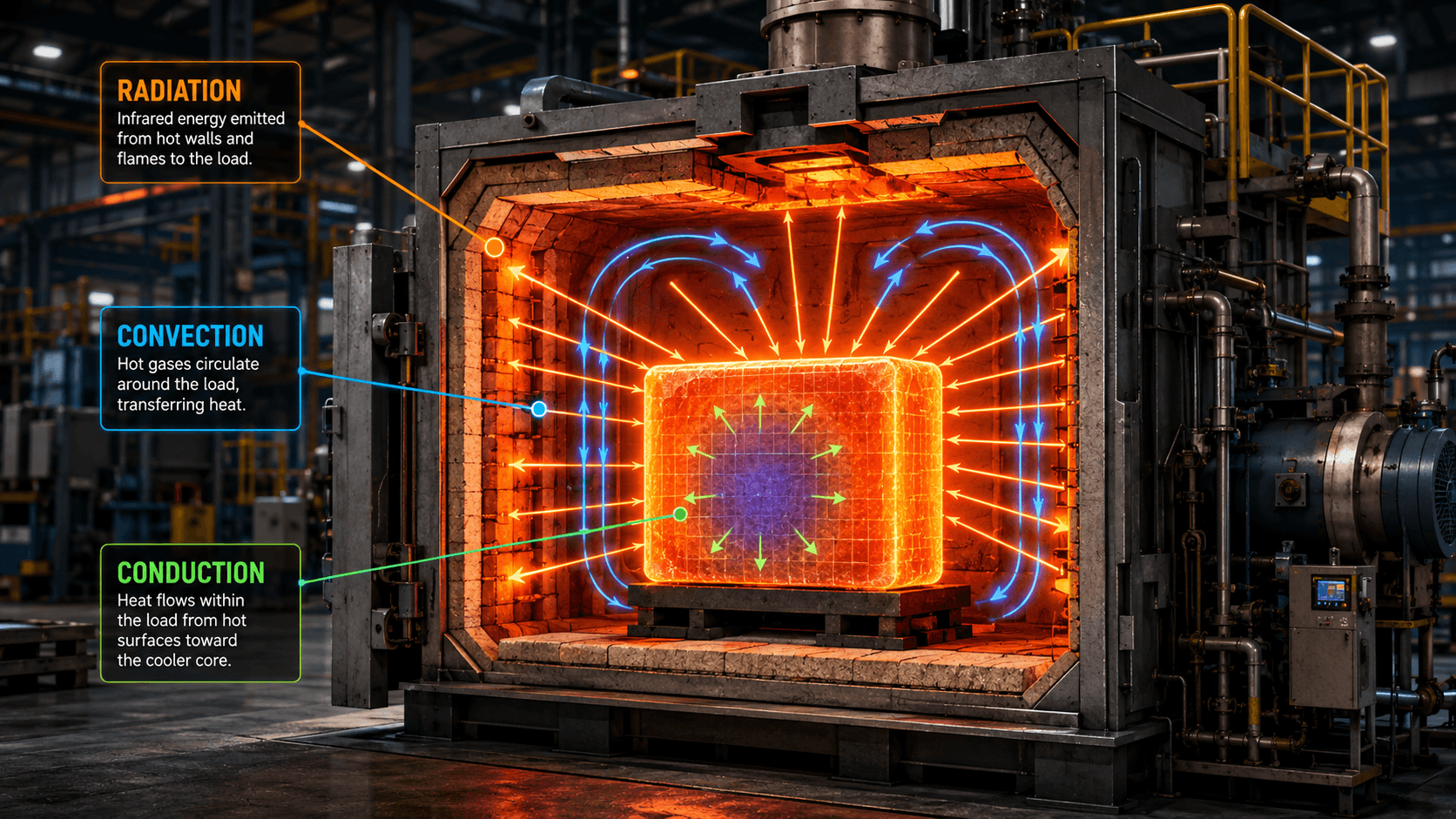
• Engineering simulation for heat transfer, airflow, steam penetration, cure behavior, or energy use
• Historical cycle records, maintenance data, deviation reports, and inspection outcomes
The value comes from connecting these layers. Instead of looking at isolated trends after a problem occurs, teams can compare expected and actual cycle behavior, detect abnormal patterns, and make better process decisions.
For Simularge, this is where engineering physics, AI, and live plant data come together. A high-value digital twin should not be a generic visualization layer. It should represent the process physics that matter for the specific autoclave application.
How an Autoclave Digital Twin Works
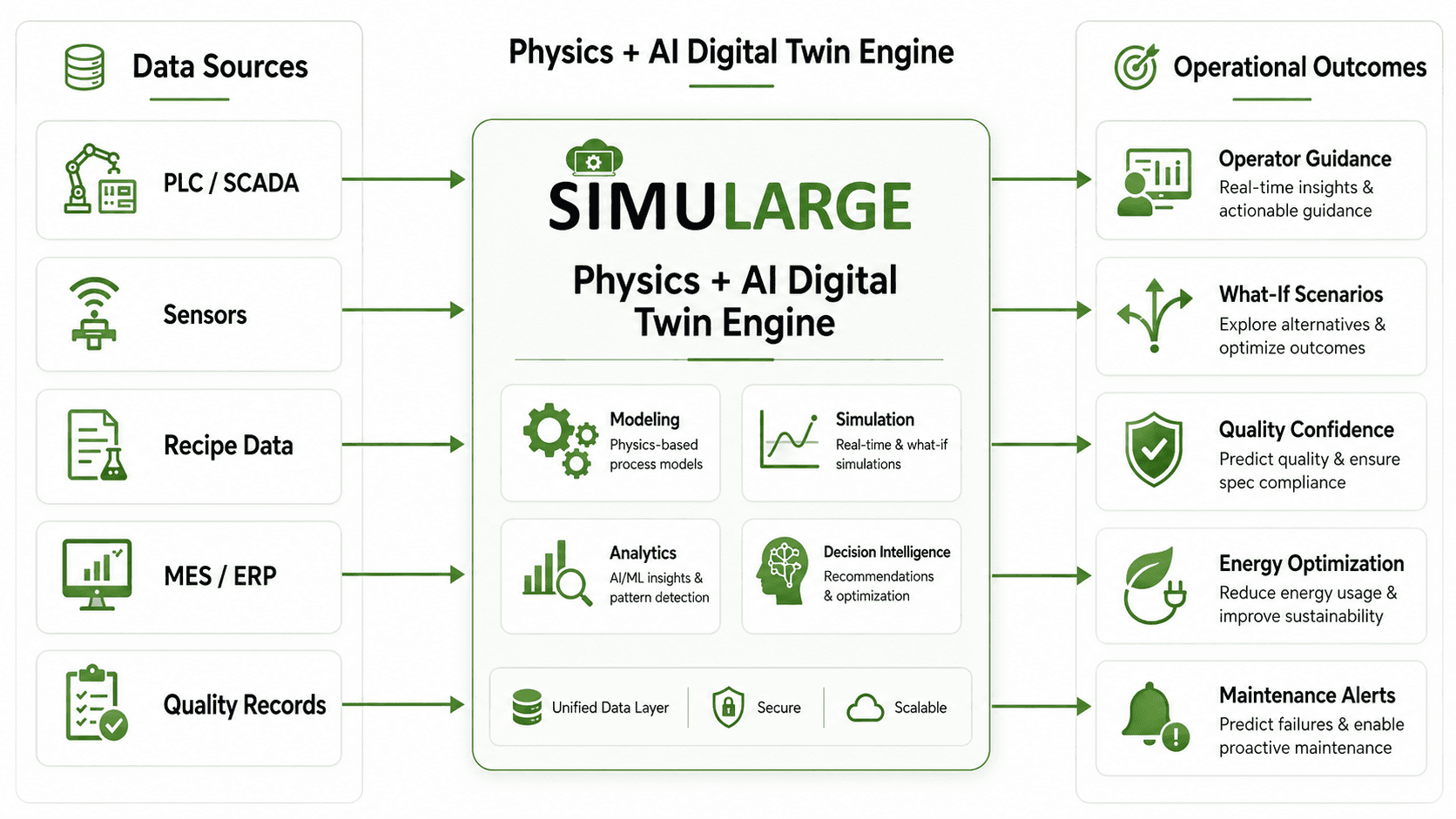
1. Connect the machine and process data
The first step is to collect data from the autoclave and surrounding systems. This can include PLC signals, SCADA history, thermocouples, pressure readings, vacuum behavior, flow data, fan speed, steam or venting information, cycle alarms, recipe IDs, batch records, and quality outcomes.
2. Model the cycle and load
The twin represents the process behavior that matters for the use case. For composite curing, this may include thermal gradients, cure progression, residual stress, and distortion risk. For sterilization, it may include load heating behavior and exposure confidence. For food retorts, it may include critical factors that influence heat penetration.
3. Compare expected and actual behavior
During or after the cycle, the twin compares live or recorded data with expected behavior. This helps teams see whether a batch behaved normally, whether a specific sensor pattern deserves attention, or whether a future recipe should be reviewed.
4. Turn insight into action
The output should be practical: recommended review points, better loading strategies, recipe improvement opportunities, maintenance alerts, deviation support, or energy optimization ideas. A strong digital twin does not overwhelm operators with raw data. It converts data into decisions.
Key Use Areas
1. Composite Curing
Composite autoclaves are used in aerospace, defense, automotive, wind, marine, and other high-performance applications. In these processes, the quality of the final part depends on the relationship between the part, tooling, material, temperature history, pressure/vacuum behavior, and cure cycle.
The SAE SMARTCLAVE technical paper presents a high-fidelity autoclave digital twin for composite fabrication, combining thermal CFD with thermo-chemo-mechanical modeling. The goal is to better understand temperature distribution, cure kinetics, residual stress, distortion, and part-placement decisions.
In simpler terms: instead of treating the autoclave as a black box, a digital twin helps engineers see how the process is likely to affect the part.
2. In-Process Quality Monitoring
Some defects are easier to understand during the process than after the process. NASA’s in-situ composite cure monitoring work highlights the value of real-time, non-destructive defect tracking during composite cure in an autoclave or oven.
For manufacturers, this points to a practical direction: connect sensor data, process models, and inspection insights so that quality is not only checked at the end, but understood throughout the cycle.
3. Sterilization and Pharmaceutical Processes
In sterilization applications, autoclaves are used to process instruments, laboratory media, pharmaceutical products, regulated medical waste, and other materials. CDC guidance identifies steam, pressure, temperature, and time as key parameters of steam sterilization and emphasizes mechanical, chemical, and biological monitoring.
A digital twin does not replace validation, indicators, biological testing, or regulatory release rules. Its value is to support understanding and documentation. It can help teams compare cycle behavior across loads, identify slow-to-heat patterns, investigate deviations, and create a clearer digital history of what happened during each batch.
4. Food Retort Processing
Food retorts are another natural area for autoclave digital twins. In low-acid canned food processing, FDA inspection guidance refers to scheduled process information such as processing method, retort type, initial temperature, time, temperature, sterilizing value, and critical factors affecting heat penetration.
For food manufacturers, a digital twin can help compare actual cycle behavior with the scheduled process, understand how container type or product characteristics affect heating, and support more consistent documentation. The goal is not to bypass validated food safety requirements. It is to make the thermal process more transparent and easier to improve.
5. Rubber, Glass, and Polymer Processing
Autoclaves are also used in materials processing applications such as rubber vulcanization, laminated glass production, and polymer processing. These processes may look different from composite curing or sterilization, but they share the same operational challenge: the final product depends on a controlled cycle, a consistent load condition, and reliable equipment behavior.
A digital twin can help these teams compare cycle histories, understand temperature or pressure variation across batches, and identify when recipe settings, load arrangement, or equipment drift may affect consistency. For plants producing multiple product types, this can turn experience-based adjustments into more traceable process knowledge.
6. Equipment Health and Energy Use
Autoclaves are often bottleneck assets. A small drift in a fan, heater, valve, gasket, vacuum system, sensor, or cooling component can create longer cycles, unstable behavior, higher energy use, batch delays, or quality investigations.
A digital twin can track cycle-to-cycle signatures and highlight abnormal patterns before they become major production issues. Over time, this supports predictive maintenance, better planning, and fewer unexpected interruptions.
The Cost of Uncertainty in Autoclave Operations
Autoclaves consume significant energy, occupy valuable production capacity, and often process high-value products. When a cycle is too conservative, too long, unstable, or poorly understood, the cost impact is not limited to energy consumption.
It can also appear as:
Unnecessary heating, dwell or cooling time
Higher energy consumption per batch
Lower equipment availability and reduced throughput
Rework, scrap, or delayed quality release
Repeated physical trials during recipe development
Longer deviation investigations
Unplanned maintenance and production interruptions
Delivery delays caused by bottleneck assets
For manufacturers, an autoclave digital twin improves process visibility by connecting machine data, load behavior, model predictions, recipe information, alarms, batch records, and quality outcomes in one process intelligence layer. This supports:
Stronger quality confidence
Faster troubleshooting
Smarter recipe development
Better energy discipline
Predictive maintenance
More complete traceability across every cycle
Even small improvements can matter when the autoclave is a production constraint. A few minutes saved per cycle, a more confident loading strategy, faster deviation review, or earlier detection of equipment drift can create measurable operational value over time.
This is why digital twin technology should not be seen only as an advanced engineering concept. In autoclave operations, better process understanding directly supports cost control. It helps manufacturers reduce hidden waste: excess cycle time, unnecessary energy use, quality uncertainty, trial-and-error engineering, and underused equipment capacity.
What Makes a Practical Autoclave Digital Twin
An effective autoclave digital twin should be built around the actual process, not a generic dashboard. For Simularge, key capabilities include:
Hybrid Physics + AI: Combine process simulation with historical cycle and quality data.
Real-Time Data Integration: Connect PLC, SCADA, IoT, ERP, MES, and quality systems.
Load-Aware Modeling: Account for product, material, tooling, container, basket, tray, or batch differences.
What-If Scenarios: Test recipe changes or loading strategies before production trials.
Operator Guidance: Translate model outputs into practical next steps.
Traceable Records: Support deviation review, audits, and continuous improvement.
From Advisory Insight to Measurable Value
Autoclave digital twin projects do not need to start with closed-loop control. A more realistic approach is to begin with one autoclave, one high-value use case, and one measurable process question: which load configuration heats unevenly, which recipe is more conservative than necessary, which cycle signature appears before a deviation, or which equipment behavior increases energy use.
In advisory mode, the twin can collect data, model expected behavior, compare real cycles with predictions, and highlight review points. Once the model proves reliable, the same foundation can support recipe improvement, loading strategy, energy analysis, predictive maintenance, and eventually more automated control strategies. This step-by-step approach helps build trust with operators, engineers, and quality teams while keeping the project tied to operational value.
Contact Simularge to explore how a load-aware autoclave digital twin can help your team reduce cycle uncertainty, improve process visibility, and reveal opportunities in energy use, throughput, and maintenance.


Ready to get started ?
If this challenge sounds familiar, let’s discuss how Simularge’s physics-based digital twin technology can be applied to your production environment.